A Propane Cylinder Next to a Fire — What's Happening Inside?
There aren't many physics equations worth memorizing for fire investigation work. This is the one I keep coming back to.
PV = nRT.
Five letters and an equals sign. It's called the ideal gas law, and despite the name, it does a respectable job describing what real gases actually do at the temperatures and pressures we deal with on a fire scene. The "ideal" part is a small fudge factor — real gases interact with each other a little, and gas molecules take up a little space themselves, neither of which the equation captures. For our purposes the difference is small enough that we don't notice it.
The reason I want you to memorize this one is that it lets you think through what's happening inside a heated container without doing any math. Not "what's the exact pressure at minute 7," but "is pressure rising or falling, and what would have to change for it to stop." That mental model is the actual tool.
Let's break it apart, then put it to work on a propane cylinder.
The Equation, One Variable at a Time
P is pressure. Whatever the gas inside is pushing against the walls of its container.
V is volume. How much room the gas has to occupy. For a sealed metal tank that's basically fixed. For a balloon or a water bottle, it can change.
n is the amount of gas, measured in moles. Don't worry about the chemistry — the practical version is "how many gas molecules are in the box." More gas, bigger n.
T is temperature. Use Kelvin, which is just Celsius shifted so that absolute zero is at zero. Why Kelvin? Because the equation falls apart if temperature can go negative, and Kelvin can't.
R is a universal gas constant. It's there to make the units work, and we don't manipulate it — we look it up. For our purposes you can mostly ignore R when thinking conceptually. It's a fudge factor that the chemists already worked out for us.
So: pressure times volume equals amount times temperature, with a unit-balancing constant on the right.
The Point is Which Way the Needle Moves
Memorize the relationship, not the numbers. If you hold three of these variables constant and change the fourth, the equation tells you what has to give.
Heat a sealed container. T goes up. V can't change (rigid walls), n can't change (sealed). So P has to rise. That's it.
Let some gas out of a sealed container at constant temperature. n drops. T and V are constant. So P has to fall.
Squeeze a balloon. V goes down. n and T are constant. P inside the balloon rises until it equals the pressure of your hand pushing in.
You can do this in your head for any container, any gas. It's a one-equation mental model for "if X changes, what does Y have to do to compensate?"
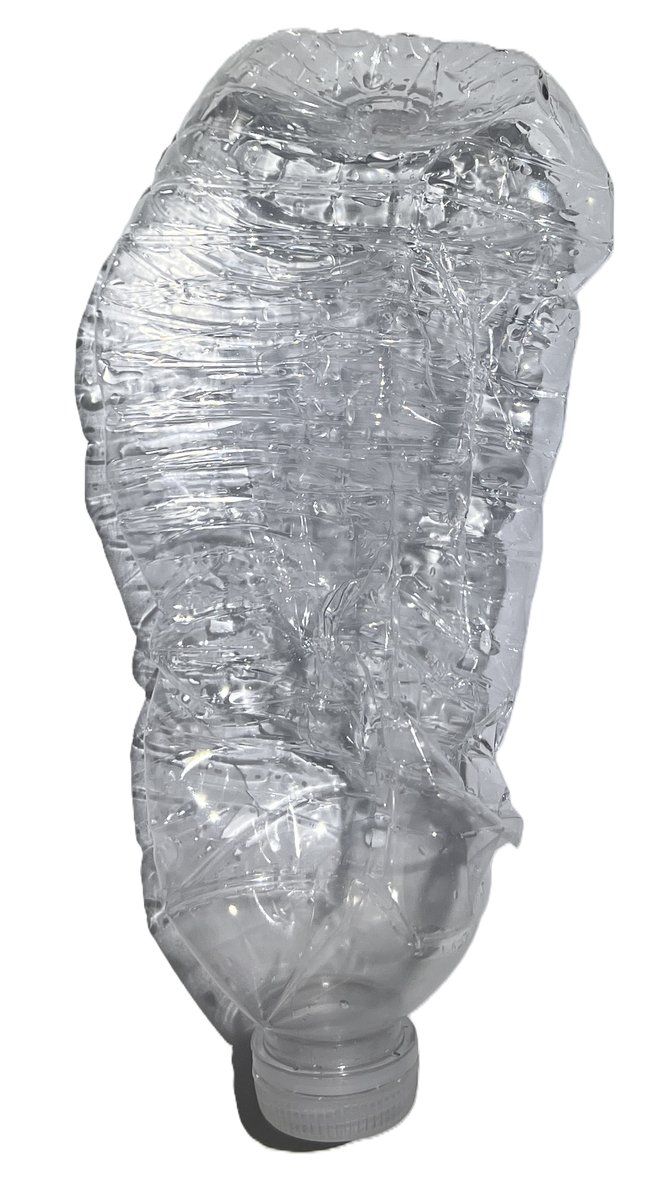
The water bottle test you can run on your next flight
The cleanest way to feel this is on an airplane.
Buy a cheap water bottle in the terminal. Drink some of it. Cap it tight before takeoff. You've just created a closed system — n is fixed inside the bottle, T is roughly the cabin temperature, V is whatever shape the plastic happens to be in, and P inside equals atmospheric P at sea level.
The plane climbs. Cabin pressure drops a bit — commercial cabins typically settle to the equivalent of 6,000 to 8,000 feet at cruise. Now external pressure on the bottle is lower than internal pressure. The bottle pushes outward until it balances. You'll watch it inflate a little over the course of the climb.
Now reverse it. Open the cap at cruise to vent, then cap it tight again. P inside now matches the low-pressure cabin. As the plane descends and cabin pressure rises, external P is now higher than internal P. The bottle crumples inward to compensate. By the time you land you've got the deformed bottle in the seat-back pocket pictured above.
That's PV=nRT at work in slow motion. T is roughly constant the whole time. n is locked. V is changing because P is changing. The system is rebalancing itself.
Fair warning: if you try this with a kid's water bottle that has a straw and a little water still in it, don't point it at the flight attendant when you open it at altitude.
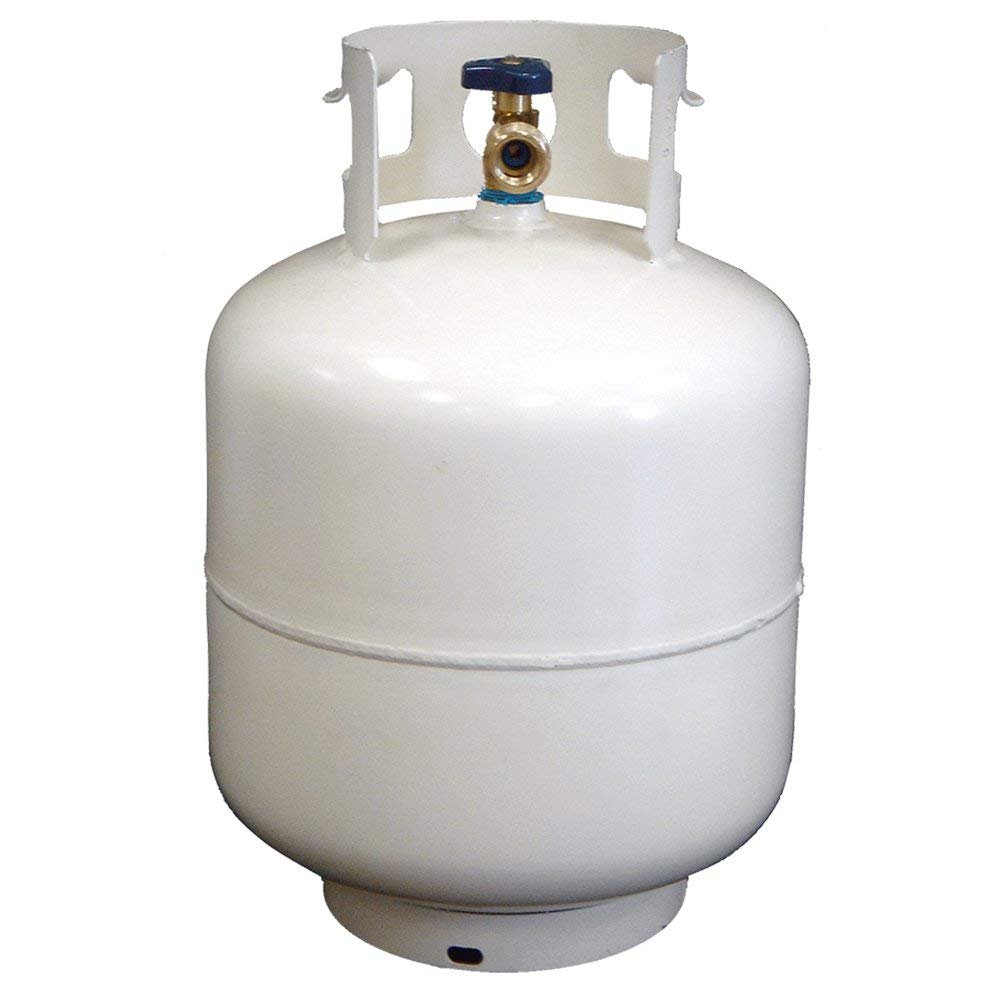
Back to the Propane Cylinder
Now apply the same thinking to a propane cylinder with a fire impinging on it.
External heat is pouring into the tank. T of the gas inside is climbing. The walls of the tank are rigid steel, so V is essentially fixed. We've got two variables locked, and a third one (n, the amount of gas) also locked for now because the gas can't get out of a sealed container on its own.
If three of the four variables are constant and T is rising, the equation says P has to rise with it. There's no escape valve in the math — heat is going in, pressure is going up.
The cylinder has a relief vent specifically because of this. As internal P approaches the tank's design limit, the relief vent opens and releases some gas. That drops n. Dropping n at constant V and rising T can keep P in check, at least for a while. The relief vent is the safety valve, in both senses.
Now consider what happens if the relief vent fails — clogged, painted over, mechanically stuck, melted shut, or simply unable to keep up with the rate at which T is climbing. T keeps rising. V can't change. n can't drop because the gas can't get out. P has only one direction to go.
It keeps rising until the tank's walls can't hold it anymore. At that point the tank ruptures. V suddenly and dramatically increases — the gas that was crammed into a small steel cylinder is now occupying the entire room or the sky around you. That's a BLEVE — boiling liquid expanding vapor explosion. The "boiling liquid" part is because propane stored under pressure is partly liquid; when the pressure releases, the liquid flashes to vapor, expanding even further.
The whole story is one equation playing out: pressure rose because temperature did, then volume rose to compensate when the steel finally gave way.
The Takeaway
You don't need to plug numbers into PV=nRT to make use of it. You need to know which variable is changing, which ones are pinned, and which one has to absorb the change. For sealed containers — propane tanks, pressurized vessels, even closed engine compartments — that mental model gets you most of the way to a defensible explanation of what was happening inside before something failed.
For anyone who likes the math, the equation does plug in cleanly with the right unit work. For the rest of us, it's a thought experiment that fits on a sticky note. At the end of the day, that's why this one earns its place in the toolbox.