You arrive at the scene. The liquid isn't gasoline.
Most of us have a decent feel for how gasoline behaves on a fire scene. Diesel too. Maybe some of the common alcohols.
But sooner or later someone hands you a story that involves a chemical with a name that requires reading twice — toluene, MEK, isobutyl methyl ketone, ethyl benzene. You need to know fast whether that spill could have produced enough vapor in the air to matter.
The fastest read on that question is the vapor pressure number on the safety data sheet. This piece is the short version of how to use it.
What's actually happening when a liquid evaporates
A liquid sitting on a counter or on a floor isn't static at the molecular level. The molecules are constantly bouncing around, and some of them — the ones near the surface, moving fastest — have enough kinetic energy to escape into the air above. That's evaporation.
Leave a glass of water on the kitchen counter for a week. The level drops. Nothing heated it, nothing stirred it. Surface molecules just kept finding the door.
Two practical consequences. First, surface area matters. A puddle of fuel on a garage floor will evaporate faster than the same volume in a bucket because there's more surface for the molecules to escape through. Second, the deeper molecules don't form bubbles and bubble up to the surface — they just sit there until they get to be the surface molecules themselves.
Vapor pressure is the pressure those escaping molecules exert
Once a molecule breaks free of the liquid and joins the air above it, it's a gas. The gas exerts pressure on whatever surrounds it. That pressure is the vapor pressure of the liquid.
As you heat a liquid, more of its molecules have enough energy to escape, so more enter the gas phase, so the vapor pressure goes up. Keep heating until the vapor pressure equals atmospheric pressure and you've hit the boiling point. That's all "boiling point" really means — it's the temperature where vapor pressure catches up to the atmosphere.
This is why water boils at lower temperatures up in the mountains. At elevation, atmospheric pressure is lower, so it takes less vapor pressure to match it, which means a lower temperature. In Denver you'll boil water at about 95°C instead of 100. Kind of interesting on its own, but the part that matters for us is the same physics in both places: vapor pressure depends on the liquid and on the temperature.
The curve that shows the difference
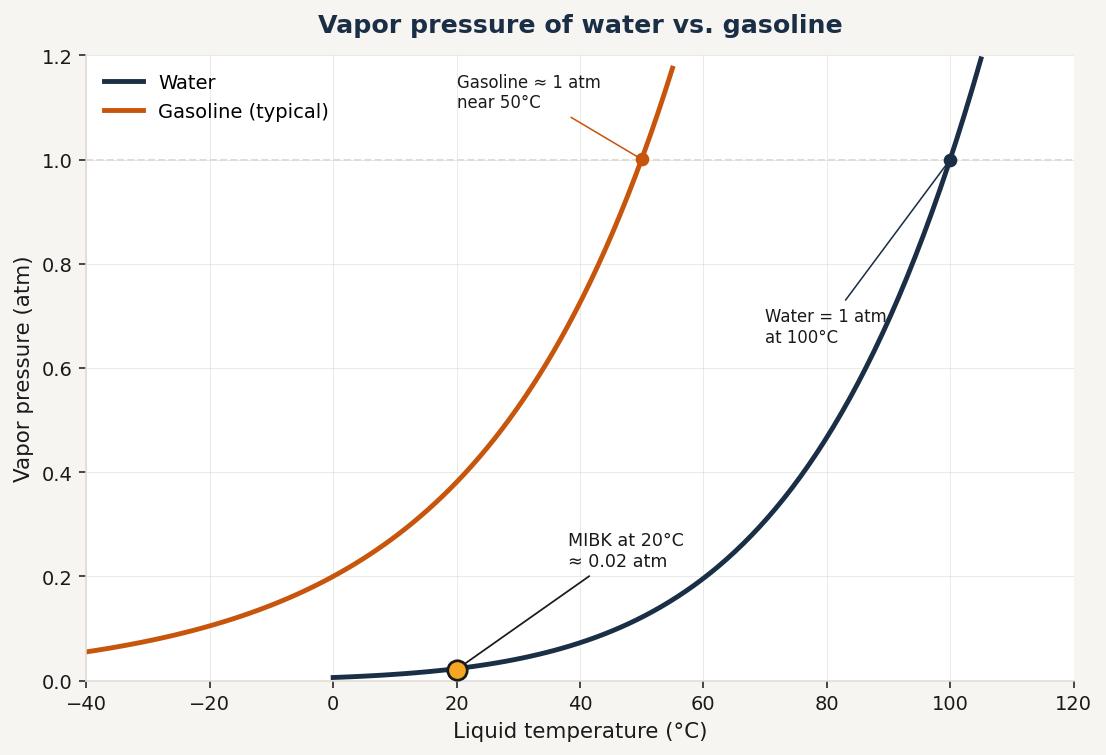
[IMAGE 1 — file: images/01-vapor-pressure-curve.jpg — alt text: Graph showing the vapor pressure of water and gasoline plotted against temperature, with MIBK marked at 20°C. Water reaches 1 atmosphere at 100°C while gasoline reaches 1 atmosphere around 50°C.]
The navy line is water. At 0°C, vapor pressure is essentially zero — ice doesn't evaporate at any rate that matters. As the temperature climbs, vapor pressure rises with it, hitting 1 atmosphere at 100°C, where it boils at sea level.
The orange line is a typical gasoline. At minus 40°C, gasoline is already exerting measurable vapor pressure. By the time you're at room temperature, gasoline's vapor pressure is in the 0.3 to 0.4 atmosphere range. By around 50°C, it's at 1 atmosphere. This is why a small gasoline spill at a normal indoor temperature produces a lot of vapor fast — the curve sits well above water's at every comparable temperature.
That gap between the two curves is basically the whole story. Anything that lives near the gasoline curve is producing vapor aggressively at pre-fire temperatures. Anything that lives near the water curve is barely participating until you heat it.
Reading an SDS sheet — the MIBK example
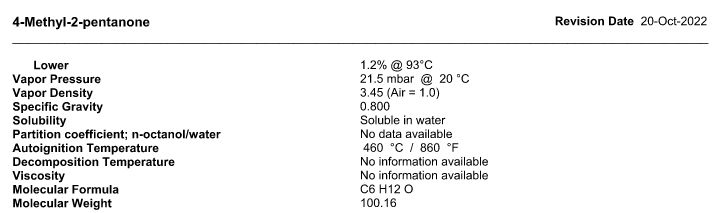
[IMAGE 2 — file: images/02-sds-sheet-mibk.png — alt text: Excerpt from a safety data sheet for 4-methyl-2-pentanone listing vapor pressure of 21.5 millibar at 20 degrees Celsius among other physical properties.]
Here's a real SDS excerpt for 4-methyl-2-pentanone, more commonly known as methyl isobutyl ketone or MIBK. The line we want sits a couple rows down:
Vapor Pressure: 21.5 mbar @ 20°C
The units are the first thing to deal with. SDS sheets are not consistent — you'll see millibar, kilopascals, mmHg, torr, atmospheres, sometimes psi. There's no standard. So before comparing anything, get the number into the same units as whatever you're comparing it to. One atmosphere is about 1013 millibar, which means 21.5 mbar is roughly 0.021 atmospheres.
Now look back at the chart. Where does MIBK at 20°C land? It's the slate blue dot near the bottom — sitting essentially on top of the water curve at the same temperature. MIBK at room temperature is producing vapor at about the same rate as water. Nothing like gasoline.
That's the punchline. MIBK has a flash point of 14°C, which is low and might lead you to expect a really volatile fuel. The vapor pressure tells a different story. Flash point answers a different question — it tells you the lowest temperature at which the vapor could ignite if there's enough of it. Vapor pressure tells you whether there's actually enough of it. Two related numbers, two different gut checks. They don't substitute for each other.
How this lands at a scene
You don't need to model anything to use this. Pull the SDS, look at the vapor pressure at room temperature, convert to the same units as your reference, and ask:
Is this in gasoline territory? If yes, the spill could produce a flammable atmosphere at pre-fire temperatures pretty fast. Treat it as a potential first fuel ignited.
Is it down near the water line? If yes, you'd need either heat, time, or a lot of surface area to build a flammable atmosphere from this spill alone. Less likely to be a fuel early in the fire, but not impossible if conditions are right.
For anything you need to actually quantify — concentrations at specific distances, time-to-flammable-mixture, dispersal patterns — hand it to a chemist or a fire engineer who can run the model. But for the first cut at "could this spill have done what someone is claiming it did?", vapor pressure on the SDS is a 30-second read that earns its place in the toolkit.
The takeaway
Vapor pressure tells you how aggressively a liquid is feeding the air above it. Compared against gasoline or water at the same temperature, it gives you a fast sense of whether a spill could produce a flammable atmosphere on its own at pre-fire conditions. Pair it with the flammable limits on the same SDS sheet and you have a useful gut check before you commit to a hypothesis.
The numbers are right there on the SDS. The only friction is unit conversion — and Google handles that for you.